
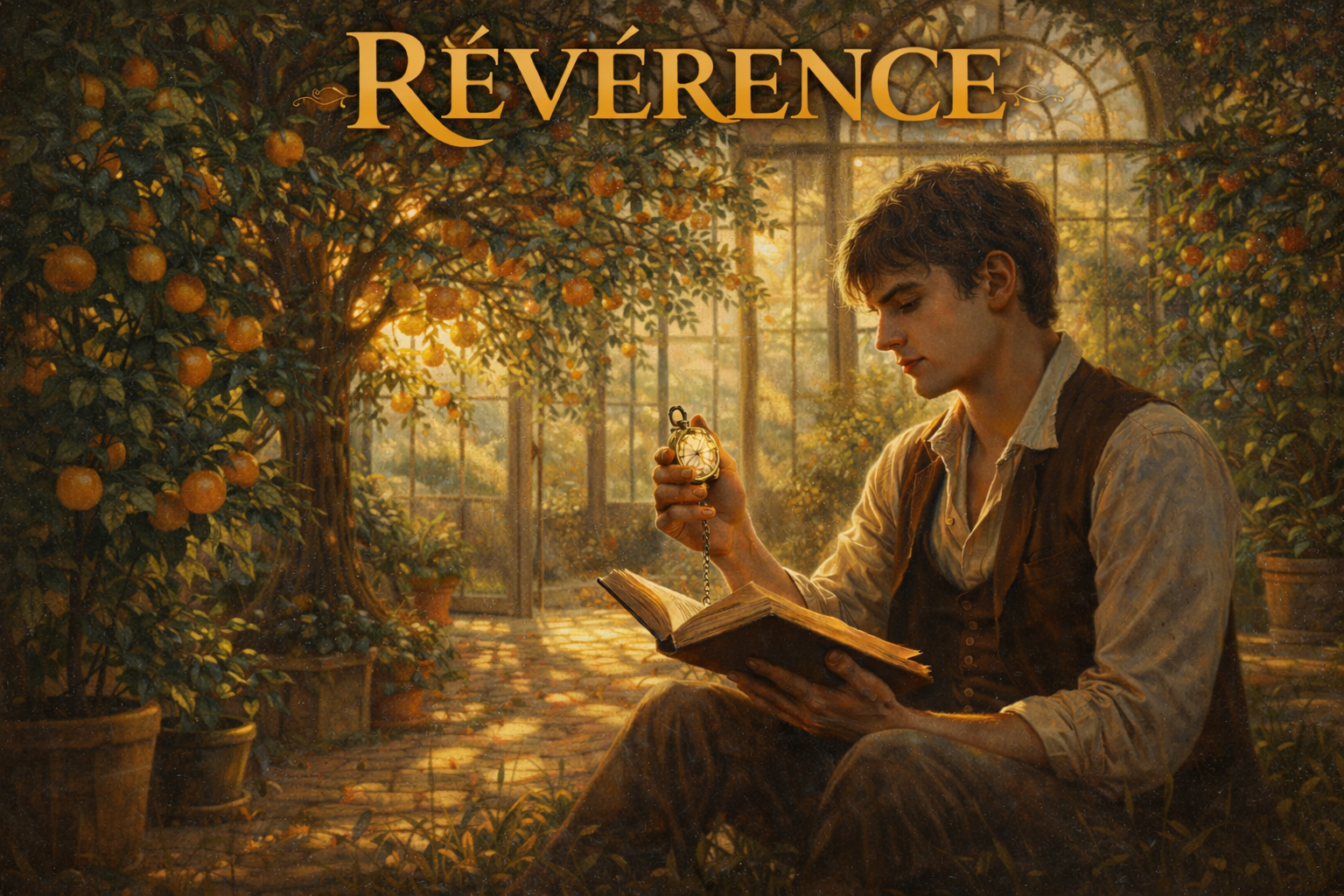
TITLE: RÉVÉRENCE
Summary: A young magician discovers his master’s greatest secret: a diamond timepiece that allows its bearer to step into another’s memories. What starts as curiosity quickly escalates, as the master turns illusion into intrusion; forcing the young magician to witness the cost of his signature trick.
CHAPTER I – RAPTURE
In the late afternoon, the Versailles Orangerie held the sun captive beneath its vaulted glass, as The Master lifted an orange from a narrow branch and turned it slowly between his fingers.
A boy of nine stood beside him in the long corridor of trees arranged with mathematical obedience.
There was no audience, no stage, no applause waiting to arrive, only light suspended in dust, and the calm authority of The Master’s presence.
He stood with one hand buried deep in his coat pocket, as he always did, as though guarding something unseen.
As he tilted the fruit, sunlight caught its skin and something impossible began to unfold: the dull surface deepened, warmed, and gathered a glow from within, until it shone like gold.
The sun moved across it like a careful hand, coaxing colour into radiance.
Magic, he had always said, was spoken of as an art, draped in velvet, performed with flourish, but he believed it was closer to a science.
It was the patient study of angles and light, of timing and distraction, of how the eye travels and how the mind fills in the spaces in between.
The Master did not smile.
He only looked at the boy and asked, softly,
“Do you see?”
***
Twenty years later, in a packed Paris theatre, a colossal orange tree stood beneath the chandeliers, its branches arcing outward in sweeping silhouettes that nearly brushed the balcony. The trunk rose thick and sculpted, pale as polished stone, its limbs twisting upward with the gravity of something ancient and ceremonial; less a tree than a monument, as though the theatre itself had been constructed around it.
The audience sat in coats and silk gowns, their voices blending into a soft murmur that moved through the hall. Gradually, the sound faded, and all attention turned toward the stage. In the front row, a young man leaned forward, eyes wide, breath held in anticipation.
This theatre had known laughter, tragedy, and soaring music.
Tonight, it was filled for one man alone — The Master.
The Master lived quietly, almost invisibly, and little was known of where he travelled or how he prepared. Rumour followed him more faithfully than fact. He gave only one performance each year, and that scarcity had become part of the spectacle.
This year, the programme bore a single title beneath his name: Gold On Diamonds.
On stage, The Master stepped forward, regal and razor-sharp, positioning himself at the edge of the light. The air seemed to tighten around him; decades of performance had worn his elegance smooth and precise. One hand slipped into his pocket while the other gestured toward the tree.
“Mesdames et Messieurs,” he began, his voice calm and measured,
“Allow me to show you the alchemy of perception”
The stage lights dimmed by a fraction, just enough for every shadow to sharpen and every sound to become audible. He gestured, and the crowd leaned forward as one.
The oranges began to shift, their skins glowing and rippling as though something beneath the surface were pressing outward, until each fruit shone with a deep golden sheen; not fruit, not illusion, but gold.
The Master calmly closed his fingers around one gleaming sphere. He twisted it gently; the stem parted with a clean metallic click. Turning with composed precision, he placed it into the hands of a lady in the front row. Gasps rippled through the theatre as it clinked against her bracelets, cold, heavy, unmistakably solid. She passed it to the young man beside her, who stared at it in disbelief; sunlight trapped in metal.
Above them, the golden fruit shuddered again, a faint tremor running through the branches as though the tree were drawing breath. For a suspended instant, nothing happened, and then it transformed again; diamonds burst from every branch, catching the chandeliers and scattering light into a thousand stars.
The Master lifted his hands, not in triumph but in command, and yet the crowd did not move. No applause came. Hundreds of faces remained fixed in the diamond shimmer, as if even a whisper might fracture the miracle suspended in the air.
Then, into the silence, The Master spoke.
“Mesdames et Messieurs,” he said evenly,
“A magician is not a deceiver of the eye, but a student of natures secrets”
On stage, The Master lowered his hands and offered a small, gracious bow; when he straightened, his gaze settled on the young man in the front row.
In that charged stillness, the young man felt something inside him shift, a belief forming that had nothing to do with God or man, but with something stranger and more absolute.
He wanted to know exactly how it worked; to understand the architecture beneath the illusion. He wanted to study the words as closely as the movements, the cadence of each syllable and the silence that framed it; the subtle shifts of posture, the placement of the feet, the invisible geometry that traced through the air.
He wanted to measure the light; how it struck the leaves, how it gathered along the curve of the fruit, how it turned skin to gold and gold to something colder and harder. He wanted to know the tree: its weight, its balance, the hidden supports buried within its trunk. He wanted to know every segment, every theory, every concealed mechanism that made the impossible appear inevitable. He did not want to be astonished.
He wanted to understand.
CHAPTER II – REVERIE
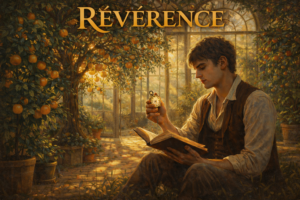
A lone ray of sun pierced the vaulted glass of the Versailles Orangerie, slipping between its iron ribs and falling in a warm column upon the orange tree at its centre. The panes above scattered the light so that the entire conservatory glowed in muted gold. Beneath the dome of glass, the tree shivered softly, its trembling leaves casting flecks of amber across the tiled floor.
At the base of the trunk, the young man knelt. He brushed soil from a leather-bound book he had unearthed; when he opened it, the brittle pages crackled in the hush. The text was written entirely in French, they were crowded with sketches; coils and wires, strange glyphs threaded between meticulous diagrams of the human brain.
He traced the ink with his fingers and whispered the words written there:
“The current of thought… carried in sparks and blood.”
His gaze dropped to the pocketwatch resting in his palm, its craftsmanship flawless, the work of a master clockmaker. Every gear and hinge had been cut with surgical precision, and at its centre, set like a frozen star, lay a smooth diamond orb.
The watch had been fashioned by the finest clockmaker in Paris, and the diamond orb at its centre was crafted by a talented young apprentice.
The diagrams in the book mirrored the claim. Copper coils wrapped through the casing like nerves, converging toward a diamond prism at the heart of the mechanism.
Beneath them, in the margin, a note had been scrawled in by a hurried hand:
“Memory is a circuit. A trick of light and nerve. Harness its power, and you may walk where another has walked.”
As the young man read, the faint hum in his palm grew louder. Sparks danced along the seams of the brass case, biting at his skin. He tightened his grip, breath shallow, as the hands of the watch began to spin faster and faster, the buzz deepening into a low, gathering roar.
“This is no watch.”
Beneath it, another line, darker in ink:
“It is a vault. An engine that runs not on gears or springs…”
The young man’s reflection split across the diamond face, splitting into multiple versions of himself, each blinking out of rhythm, each caught in a different moment of his own past.
He read the final line.
“…but on the same current as the human mind.”
The Orangerie began to blur. The floor, the trees, the glass ceiling above him faded at the edges. Everything around him softened, as if it were being washed away.
The diamond surface seemed to open beneath his gaze. It pulled him forward. The world beyond the glass dissolved, and he was drawn through the watch face into a vortex of fractured time.
A sudden gust of wind swept through the Orangerie, cold against his skin. The pages of the leather-bound book slipped from beneath his fingers and turned rapidly on their own, flipping toward the end.
They came to rest on the final page.
Three LETTERS, written in ink so dark it looked scorched into the page — the colour of burnt orange, or perhaps dried blood:
CHAPTER III – RUIN
The descent through the watch was not a fall but a thinning, layers of time peeled back. Sound lagged behind sight; light fractured before it fully formed. Memories did not appear in sequence but in fragments, as though shuffled by an unseen hand.
The watch did not send him back through time. It allowed him to relive a life that had already been lived. He remained aware of his own thoughts, but he could not change what happened. Every word, every choice and every step had already been made, and the memories unfolded exactly as they had before. He could question them, fear them or wish they were different, but he could never alter them. The past moved with the certainty of a clock. Its purpose was not to be changed, but to change the one who inhabited the memory.
The orangerie gone.
He stood in the French countryside at dusk.
Little was known of The Master’s early life. In Paris, he was a figure of precision and polish, immaculate, distant, self-contained. But here, the land lay open and plain. Fields rolled gently beneath a violet sky. In the distance, a small stone estate stood in stillness, age settled into its walls and roof. A solitary lantern burned by the door, firm in the dying light.
This was no palace of velvet curtains and chandeliers. This was soil and labour and silence.
The Master had not been born beneath stage lights. He had grown from this; from poverty, from obscurity, from a life where survival demanded ingenuity long before applause ever did.
A simple orange tree rose beneath a scatter of cold stars, the fruit quivering in a faint metallic glow.
The tree no longer looked natural. It stood twisted against the starlit sky, its branches bending at unnatural angles, bark stretched too tight across its limbs as though something beneath were forcing its way outward. It felt grotesque and out of place in the vast open space and it had the stillness of something assembled, not rooted; a machine wearing the mask of a tree.
He reached towards the nearest fruit. Before his fingers touched it, he heard a faint tick. He froze. The orange hung motionless, its skin dull once more. “Take me back,” he whispered, but only silence answered. Night fell, and with nowhere else to go, he slept beneath the branches. Morning came, yet the watch remained still. He searched the field again, convinced he had missed something, but found only the same lonely tree standing beneath the empty sky.
Days became weeks, and weeks became months. The same cloud drifted across the same corner of the sky each morning. The same bird crossed overhead each afternoon without ever landing. The memory unfolded with merciless precision, correcting every attempt he made to escape it. No matter how far he walked, no matter where he searched, he always found himself back beneath the tree, as though time itself refused to permit another path.
The tree became his only companion. At first he studied it simply to occupy the endless hours, tracing the shape of its branches, counting its fruit, watching the shadows drift across its bark. But as the months dissolved into years, observation became devotion. He began to notice how the morning sun pierced the eastern leaves without ever touching the western fruit, how dusk gathered beneath the branches long before the surrounding field surrendered its light, how every orange caught the evening differently, some burning gold for only a heartbeat while others remained untouched by the sun. He watched the light move through the canopy until he could predict where it would fall before dawn had broken, memorising every branch, every leaf, every subtle shift in colour as though the tree were teaching him a language no one else had ever learned.
In time he ceased looking for a way to escape. Instead, he waited for sunrise. Then sunset. He returned each day to the same place beneath the branches, convinced that if he watched long enough, the tree would reveal the secret hidden within its light.
Years passed.
He watched the tree so relentlessly that he began to believe it was waiting for him. Every dawn he searched the branches for the smallest imperfection, every dusk he lingered beneath the canopy convinced that tomorrow would reveal what today had concealed. The tree remained silent, feeding his obsession with its unchanging perfection.
Then suddenly one day a single orange split open. Its skin peeled back to reveal brass beneath, delicate gears twitching, a diamond dial spinning wildly at its core — ticking.
Another burst, then another; orange stiffened into metal, pulp tightening into cogs, until the entire tree drooped under the weight of pocketwatches. Hundreds of them. All ticking.
The young man staggered back and rubbed his eyes, as though he could scrub the vision away. The ticking followed him, louder now, more synchronized, less like time being kept and more like time engulfing him.
Was this real magic? Not the measured elegance The Master had once revealed beneath calm afternoon light, but something raw and mysterious; something that did not seek applause, only obedience. Each tick struck sharper than the last.
The field was empty.
Only the tree remained, its branches trembling as the ticking rose in a torturous unison.
The Master’s voice cut through it, steady and merciless:
“To see is to suffer.”
The ticking surged; faster, louder, overwhelming, until it was no longer a sound but a force.
The watch had started to tick.
The young man looked down.
The calluses were gone.
The cuts that had mapped his hands had vanished without trace. The burns, the scars, the years of labour had been lifted from his skin as though they had never existed.
Yet the hands staring back at him were not the hands he had entered with.
They were younger. Much younger.
CHAPTER V – RETURN
The young man is only a boy when he plants the seed at dusk. He presses it into the soil with his thumb until the earth lies smooth and closed. The cut on his finger opens again, and a drop of blood falls into the dirt, disappearing without a trace. He does not see it. He simply stands there, staring at the small patch of ground, as if something has already begun beneath it.
A flash in the gravel catches his eye and brings him back to his knees. He lifts a shard of diamond from the stones, rough and uneven, sharper than it looks. It slices cleanly into his palm. Not a graze, a split. Blood rises at once, filling the cracks of the broken stone instead of dripping away. He draws in a breath and holds it.
When he lifts the shard to the sinking sun, the light gathers unnaturally within it. White warms to amber. Amber deepens to a gold, as though the stone has drawn the evening inward. The field dims around him, the wind stills, and only the shard remains luminous in his bleeding hand.
He stares at the blood pooling in the diamond’s broken veins, and in the hush of the field a voice returns to him.
“Do you see?”
He turns sharply, breath caught in his throat.
There is no one there.
The orange trees are gone. The watch is gone. Only the diamond shard rests in his hand, the thin cut across his palm the sole proof that anything has happened.
He turns in a slow circle, waiting for the world to correct itself, for the air to shift and restore what he recognises, but nothing changes. There is no path back, no mechanism to reverse what he has stepped into.
In the suffocating quiet, he understands with a cold, settling clarity that he has crossed into a place that will not release him, and that if time is to move again, if the tree is ever to stand where it once did, he will have to rebuild the watch himself.
He begins by walking.
The field does not answer him, but it does not confine him either. Days later, or perhaps years; time has already grown unreliable; he finds the edge of a village, then a road, until at last the sprawling mass of Paris rose before him in smoke and stone.
He is still a boy, thin and obedient, with seeds in his pocket, a diamond shard and a scar across his palm. He watches the shop windows until he finds what he needs: clocks in every shape and size, pendulums swaying, gears whispering behind glass. He stands there until the proprietor notices him. The clockmaker is stern but not unkind; he sees in the boy’s fixed gaze something more than curiosity, yet he hesitates; reluctant to take on a child who seems to favour only one hand, the other rarely leaving his pocket. Work at a bench demands two steady grips.
Still, there is something in the boy’s stillness that persuades him. An apprenticeship is offered, sweeping floors, polishing cases, filing burrs from brass teeth; nothing more.
He accepts without hesitation.
By day, the boy learns the discipline of time: how to seat a wheel without forcing it, how to balance a spring so it neither drags nor snaps, how to listen for the smallest irregularity in a tick. He watches hands older than his move with precision, memorising each motion. He keeps his own hands steady, his questions few. He does not speak of trees or vanished watches.
By night, after the shutters are drawn and the workshop falls into shadow, he remains behind. From discarded scraps he gathers brass filings, bent pins, fractured mainsprings. He studies the movement of finished clocks and then dismantles them in his mind, imagining how they might be altered, inverted, made to do more than measure hours. The master clockmaker believes the boy has an unnatural devotion to craft. He notices the boys notebook taking shape— the hidden sketches, the drawings of improvised clamps, the strange geometric designs.
When at last the boy is strong enough, he begins to build his own device in secret, not to mark time but to pierce it; and so, year after year, shift after shift, he labours at two benches; one for wages, one for escape.
He builds the watch with one hand.
The other stays buried in his pocket. It takes him decades.
He anchors the brass in a wooden vice bolted to the bench, tightening it with his elbow and shoulder. When he files the casing smooth, he leans his full weight into the stroke, guiding the metal in slow arcs, stopping often to check the curve against the light. He cannot hold two pieces at once, so he fashions small wedges and clamps, carving them from scrap wood until they hold what his hidden hand cannot.
To drill the hinge, he fixes the casing upright between padded vice and turns the bit with deliberate pressure, lifting, clearing, lowering again; the rhythm careful, almost ceremonial. When the bit slips, he begins again.
The mainspring demands the most patience. He braces the barrel against his chest, using bone and breath as counterweight while his working hand coils the steel inward by fractions. If it springs loose, it snaps across the room. It does this twice before he masters it.
The gear train must be aligned without tremor. He steadies his wrist against the bench, breath held, lowering each wheel into place as though setting bone. Without a second hand to guide, he tilts the plate and lets gravity finish what flesh cannot.
The escapement resists him. It always does. With only one hand to adjust the pallets and seat the fork, the balance slips, tips, refuses its axis. He studies it for days, shapes a sliver of copper into a hook fine enough to nudge the wheel into alignment. At last, it yields.
At last, he lifts the diamond shard.
His hand trembles, not from doubt, but from the weight of how long it has taken to reach this moment. He lowers the shard into its cradle at the centre of the movement. He turns it carefully, fitting the fractured edge into the mechanism until the diamond locked into the centre, and settled in the core.
By the time the casing closes and the mechanism settles into place, he is an young man.
The watch does not tick at first.
Outside, the orange tree shudders in a sudden wind.
Inside, a single click.
And with time, he quietly passes into memory.
The watch finally begins to tick.
CHAPTER VI – REVELATION
He was no longer walking through the theatre itself, but through a memory the clockmaker had preserved within the watch. The theatre was empty. Rows of vacant seats dissolved into shadow while dust drifted through the dim air. When the last footsteps faded into the dark, he stood and made his way to the tree.
The boards creaked softly beneath his weight. The tree loomed in the half-light, stripped of its radiance, branches still and ordinary, fruit dull and lifeless.
He moved slowly around its base.
Then he saw it.
The soil had been disturbed. He knelt and brushed it aside with careful fingers, peeling back the painted canvas that mimicked earth.
Copper wires lay coiled beneath the trunk, threading through the roots, running upward along an inner spine. They were not vines.
They were conductors.
His breath caught.
He had heard of such force before; a strange new current whispered about in lecture halls and salons, a power that leapt through metal and burned without flame.
He had thought it was pure myth.
He reached forward.
When his fingers touched the wire, a faint snap bit at his skin. He did not withdraw. Instead, he pressed the contact into place.
A low hum stirred beneath the stage.
Then, slowly, deliberately, light begins to travel upward through the trunk. The fruit flickers, then glows, each sphere gathering brightness until the branches shimmer once more.
It is activated.
The young man leans closer.
Now he sees it. The current flows through the copper and warms the fruit from within. Beneath each orange, hidden under its skin, a thin shell waits — light metal coated in gold leaf, balanced just enough to feel real in the hand. When the current moves through it, the surface glows and tightens, heat giving it weight, weight giving it presence.
But that is only the first illusion.
Inside each fruit, set deeper at its core, rested a second form; round, precise, enclosed in a narrow rim of brass. Its surface was cut into sharp facets that caught even the smallest glint and multiplied it. Around its edge ran a fine groove, almost like a seam, as though the sphere had been fitted carefully into its casing.
When the current shifted, not louder, but finer, faster, something within responded. The hidden seam released. The golden shell split cleanly along its curve, parting just enough for the inner crystal to emerge.
The gold fell back.
And the light changed.
The young man spun around. The Master stood in the doorway, one hand resting inside his coat as always, his face carrying neither anger nor disappointment. He stepped forward and gently closed the watch within the young man’s hands instead of taking it away. “You believe this contains my trick,” he said. The young man lowered his eyes, unable to answer. The Master nodded once. He placed his own hand upon the watch. The diamond at its centre brightened until it burned white, and the workshop dissolved around them. The young man felt himself pulled sideways through light instead of forward through space. When the brightness faded, he was no longer standing beside the Master. He was standing alone.
Years poured through him with unbearable speed. He felt hunger gnaw until it became ordinary. He felt blistered fingers split upon cold brass before hardening into calluses. He watched every failed mechanism collapse beneath exhausted hands. He buried friends. He abandoned comforts. He laboured through decades of solitude while the same impossible question consumed every waking thought. Every scar the Master carried bloomed across his own body, every disappointment settled into his chest, every sacrifice became his own. When at last the memory released him, he collapsed onto the workshop floor, gasping, his hands shaking as though they belonged to an old man. The Master remained standing above him. “If you want my trick,” he said softly, “you must first survive my life. Only then will I show you the magic.
The diamond shattered. The gears cried out. Light burst through the broken glass until the theatre, the tree, and young man disappeared within it.
CHAPTER VI – RESISTANCE
The young man returns to the workshop obsessed with recreating the transformation he witnessed in the theatre. The gold is achievable. After weeks of experimenting with light, polished metals, gold leaf, reflectors and carefully regulated electrical current, he finally succeeds in producing fruit that glows with convincing warmth. The illusion is beautiful. It is elegant. Anyone watching would believe they were holding solid gold. For the first time, he feels that the Master’s secret is within reach.
But the gold is only the first movement.
The true miracle is the birth of the diamond.
He begins constructing delicate mechanisms inside each orange, tiny brass shells designed to split apart and reveal a crystal at precisely the right instant. Every adjustment demands greater current. Every increase in current produces greater heat. The mathematics seem correct, yet every attempt ends the same way. The shell warps before it opens. The crystal clouds. Springs snap. The fruit blackens from within.
Months pass.
The workshop slowly fills with failed oranges; shelves lined with scorched fruit, warped brass casings and cracked diamonds that caught the light beautifully for only an instant before destroying themselves. He keeps every one of them, unable to throw away the evidence of another lesson learned.
His failures become increasingly violent.
On one attempt the shell bursts before he can step away, scattering molten brass across the bench. On another, the diamond fractures under the temperature change, sending razor-sharp splinters into his hands. He instinctively catches the falling mechanism, only to realise too late that the brass has become almost white-hot. The burns blister immediately.
He bandages his hands and begins again the following night.
The burns become familiar.
Skin hardens, then splits. Fresh scars cross older ones until he can no longer remember which experiment caused which wound. He discovers that gloves rob him of precision, so he abandons them entirely. Every improvement costs him another layer of skin. Every refinement demands that he hold the mechanism a little longer before letting go.
The Master watches without interruption.
He never tells the young man to stop. He never offers the solution. Occasionally he walks past the bench, examining another ruined orange before quietly placing it back where it came from. He understands something the young man does not: that solving the problem is only half the apprenticeship.
One evening, after another failure leaves fresh burns across both palms, the young man finally loses his composure. He throws the ruined fruit across the workshop and demands to know why the Master will not simply show him how it is done.
The old man picks up the shattered mechanism and turns it over in his hands.
He tells him that anyone can learn to make something shine. Gold is only craftsmanship. Diamonds are something else entirely.
The young man does not yet understand, but he returns to the bench.
He rebuilds the mechanism.
Again.
And again.
CHAPTER VII – RESURGENCE
The theatre was full. Every seat was taken, from the front row to the highest balcony. People stood shoulder to shoulder along the walls and filled the aisles, unwilling to miss the moment.
At the centre of the stage, the tree rose — vast and unnervingly precise. Its trunk stood perfectly vertical, smooth and pale, widening at the base with architectural certainty. Branches extended in flawless symmetry, each limb mirrored by another, balanced in such exact proportion that it felt engineered, deliberate, almost calculated in its design.
Every fruit hung in perfect spacing, each one the same size, each one set at the same distance from the next. Nothing sagged. Nothing grew out of line. Even the leaves appeared placed with careful order, as though the tree had been arranged by design rather than grown by nature.
On the stage of the Theatre of Wonder, the young man gestured toward the tree, his voice steady despite the streak of blood trailing down his wrist.
Youth returned to him.
The feeling was magnetic. His posture straightened without effort. His breathing slowed. His gestures aligned with a rhythm older than thought. Every movement followed the next with absolute certainty, as if he were tracing grooves worn long before he arrived.
“Memory is a circuit,” he declared. “A trick of light and nerve.”
The crowd shifted, uneasy but transfixed, as he began to circle the potted tree.
“Harness its power… and you may walk where another has walked.”
The fruit trembled. A shimmer passed across their skins, and the oranges turned metallic, rippling until they shone as gold. Gasps broke across the hall. One lady clutched a fallen fruit and recoiled at its heat, nearly dropping it from her gloved hands.
The glow climbed the branches, the gold hardening and then fracturing; beneath the cracks, light refracted in blinding shards. The audience rose to its feet, suspended between awe and terror, as if uncertain whether they were witnessing mastery — or the unraveling of it.
“Ladies and gentlemen,” the young man said, his voice carrying cleanly through the charged air, “this is not mere fruit. It is a vault.”
A hush settled over the hall, dense and breathless, as though the entire theatre were suspended on the edge of a single inhalation. The golden branches trembled faintly behind him, and no one dared to move.
His hand burned openly now, blood dripping onto the stage boards. In the shadowed galleries, The Master gripped his own fist and winced, as though feeling an echo of the pain. The young man forced a composed smile and lifted the blazing pocketwatch higher.
“A light that shines not by oil or flame…” he began, the silence thickening around him as the audience strained for the final words.
“…but on the current of the human mind.”
For a moment, nothing happened.
Then the nearest fruit quivered.
A murmur rippled through the front rows. The fruit responded at once, its golden surface flickering, brightening where curiosity sharpened, dimming where doubt gathered. A woman clutched her husband’s arm in disbelief, and the fruit above her flared white-hot, cracking along invisible seams. A man in the balcony narrowed his eyes in suspicion, and the branch near him blackened briefly, the gold cooling toward iron before flashing back to brilliance as his resistance faltered.
The tree was no longer changing at the magician’s command.
It was answering the room.
Gasps swelled, and with them, the fruit swelled too, growing brighter, heavier, trembling under the weight of collective anticipation. Fear moved through the crowd like a current, and the branches thrashed as though caught in a rising storm. Somewhere in the upper tiers, a laugh, sharp, disbelieving split the silence. Instantly, one fruit burst apart in a sudden flare, scattering sparks across the stage.
The young man did not move.
Sweat traced his jaw. Blood slipped between his fingers and hissed against the casing of the watch.
“Do you see?” he asked softly.
The theatre inhaled as one.
And the tree answered.
The golden fruit loosened and fell, one by one at first, then faster, each impact ringing sharply against the floorboards before splitting open in bursts of white light that shifted in colour as they exploded.
The detonations began to synchronize with the rhythm of the audience itself, applause stuttered into gasps, gasps sharpened into cries, and the stage responded in kind. The hall no longer felt like architecture but like a nervous system, each spectator a firing neuron, each fruit a visible synapse igniting in answer.
The explosions answered one another across the stage in a chain of blinding flashes, until the entire hall seemed to pulse as a single, luminous organism — breathing, flickering, alive.
Then something shifted.
The brilliance did not fade.
It steadied.
The crowd, sensing its own influence, tried to quiet itself. Breathing slowed. Shoulders stilled.
The fruit calmed in response.
The branches ceased their thrashing and held a low, radiant glow, as though balanced on a knife-edge between chaos and control.
And in that suspended moment, performer and audience locked in mutual current; the young man lowered the watch by a fraction.
Only then did the light recede.
When the brilliance finally faded, no one moved. Not a single body rose, not a hand reached for the aisle. Programs slipped silently from trembling fingers. Faces remained fixed in stunned disbelief, eyes wide and unblinking, as though the theatre itself had been struck motionless by the force of what it had witnessed.
In the shadowed gallery, The Master remained still, one hand buried deep in his pocket, his gaze fixed on the stage.
Below him, through the stunned silence, the young man stepped forward to the edge of the boards. He lifted his eyes and held The Master’s stare. Then he lowered himself into a majestic bow.
As he rose, he slipped his coat from his shoulders. The fabric slid down his arms and fell at his feet.
Beneath it, his forearms and torso were etched with burns and bruises that spread across his skin like the roots of a tree, not random wounds, but a network, branching and burrowing, as though something had been growing inside him for years.
Slowly, he raised his arms.
Light poured in from every direction, from the chandeliers blazing overhead, from the stained-glass windows burning with colour, from the trembling shards scattered across the floor. It did not soften him; it exposed him. The glow surged from the pocket watch in his palm and raced along every mark, tracing each scar as though following a map carved in flesh.
One by one, the wounds answered. They brightened. They awakened. What had once been damage now gleamed like living script; a record of blood, soul and time.
Veins became filaments of brilliance. Burns hardened into facets; bruises deepened into seams of gold. His hands rose, blazing with a cold, impossible clarity; not healed, but remade.
From the chandeliers overhead, molten light descended and gathered in the air above him, sealing the final moment of his transformation — a shimmering crown of gold and diamonds.
The young man tilted his head back, eyes bright with something fierce and unnameable — not triumph, not madness, but something that burned between the two.
People rose to their feet. Voices lifted, “Incroyable!”, “Magnifique!”, “Phénoménal!” — clear and unrestrained, some laughing, some close to tears.
Strangers turned to one another with wide eyes and flushed faces, as if they had witnessed something sacred together. The applause erupted, crashing through the hall like thunder. It swelled and carried on, strong and unwavering, until the entire hall seemed to pulse with a single, united heartbeat.
At the centre of it, the young man stood still, arms outstretched. He let the noise pour over him, drawing it in without flinching, as though he could feel its force settle into his bones. Yet even as he absorbed the frenzy, his eyes moved past the crowd, searching the shadowed gallery for one face alone.
Across the theatre, The Master slowly rose to his feet.
For a brief moment, he inclined his head in a small, measured bow; restrained and deliberate, before withdrawing his hand from his pocket and beginning to applaud. Beneath the lights, his withered hand was revealed, marked with the same etched scars as the young man.
On stage, for a fleeting instant, the young man’s shadow stirred.
It climbed the wall behind him, rigid and unmistakable; The Master’s outline, severe and precise, but only for a breath.
Then it began to change.
The shoulders broadened, the edges thinned, the arms unfurling into branching limbs. The spine thickened and rooted, spreading downward in dark veins.
The silhouette stretched farther, widening and rising until it no longer resembled a man at all, but the tree itself.
THE END
© Amil Prema
*Authors Note:
While researching nineteenth-century France, I became fascinated by Jean-Eugène Robert-Houdin, the celebrated clockmaker who transformed the art of magic. Among his most remarkable creations was The Marvellous Orange Tree—an illusion in which a lifeless tree appeared to blossom, bear fruit, and reveal glittering treasures before a mesmerised audience.
Years later, another young magician, Ehrich Weiss, became captivated by Robert-Houdin’s work. His admiration ran so deep that he adopted the name Harry Houdini, carrying part of his hero’s identity into his own. Their connection has often been described as one of influence and inheritance, but it also raises a more intriguing question.
At what point does admiration cease to be imitation?
When does the student become The Master?
And if one spends a lifetime pursuing another’s legacy, where does one identity truly end and the next begin?