
TITLE: Language: Time Music & Play
For most of human history, language has been treated as a practical technology. It allows people to exchange information, coordinate action, and transmit knowledge across generations. From this perspective, good language is precise, efficient, and unambiguous. Errors are flaws and clarity is the highest virtue.
Yet language has always done more than convey facts. It shapes how humans experience time, identity, and reality itself. Long before writing systems or formal grammar, language helped humans imagine futures, remember pasts, and inhabit shared worlds of meaning. Some writers make this shaping power visible. Through their styles, they reveal how language does not merely describe experience, but actively structures it.
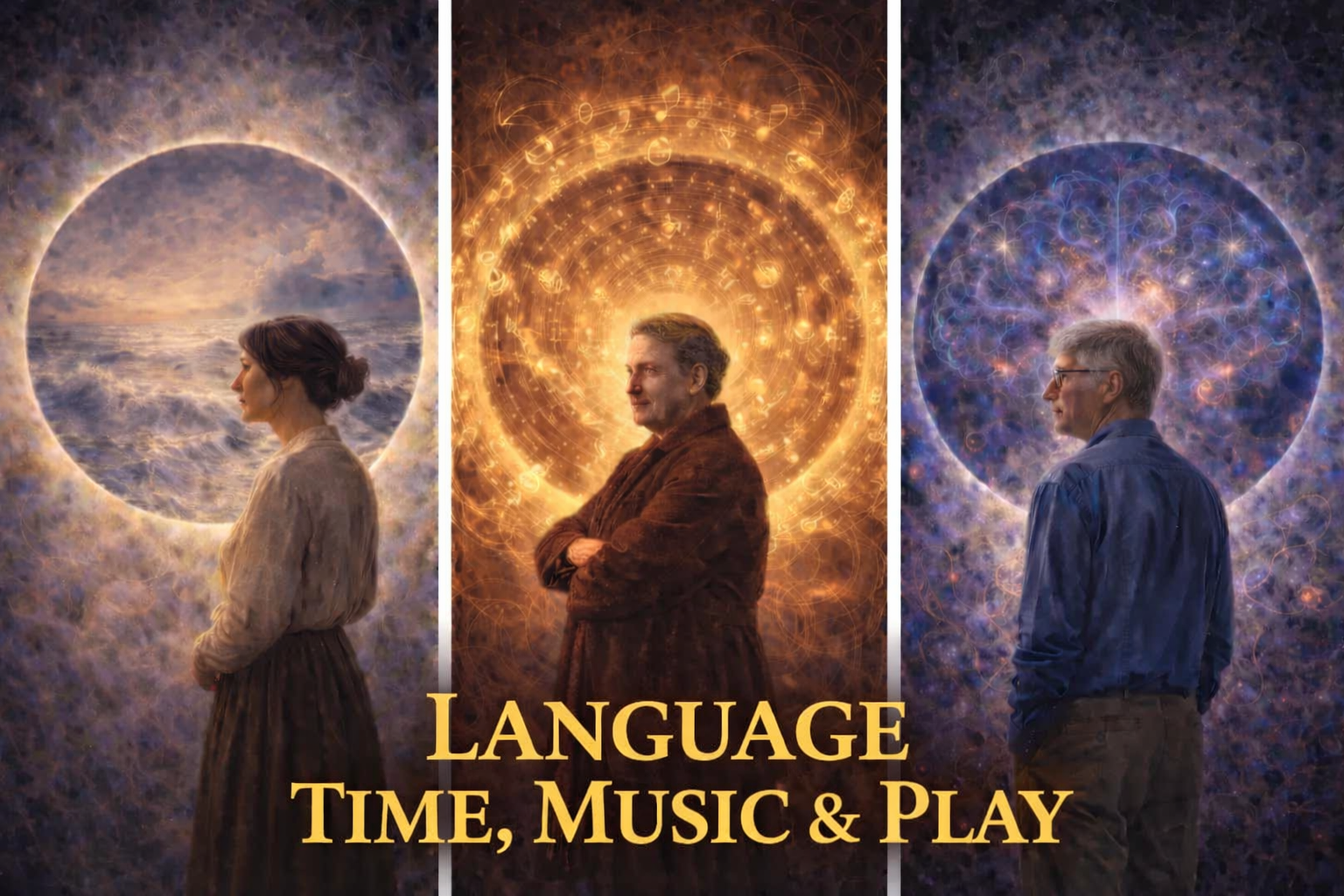
Virginia Woolf, Gertrude Stein, and Douglas Hofstadter belong to different eras and disciplines, yet each exposes a fundamental truth: how something is said determines what can be thought.
Virginia Woolf and the Experience of Time
Human consciousness does not experience time as a sequence of identical units. Minutes stretch or collapse depending on memory, emotion, and attention. Yet most language treats time as linear and uniform. Virginia Woolf however, refused this simplification.
Her writing follows the movement of consciousness itself. Thoughts drift between past and present. Sensations interrupt ideas and memories surface without warning. Sentences lengthen, loop, and dissolve, mirroring the way awareness unfolds inside the mind.
In The Waves, individual voices end up merging into one collective rhythm. The reader observes characters moving through time but also how they inhabit it. She doesn’t present information in a straightforward way; for her meaning accumulates slowly, not through events, but through immersion.
Woolf’s style demonstrates that language can record lived time rather than measured time. It captures how humans actually experience duration—not as clocks do, but as minds do; as something subjective.
Gertrude Stein and the Power of Repetition
If Woolf reveals time, Gertrude Stein reveals perception. Modern societies often assume that repetition drains meaning. Repeated words become clichés. Familiar phrases lose force. Stein showed the opposite can be true.
Influenced by music and visual art, she treated language as material rather than transparent. Words were sounds before they were symbols and repetition, in her hands, altered perception. Each return of a word shifted its weight, tone, and emotional effect.
Her famous line, “a rose is a rose is a rose,” does not explain the rose. It re-presents it. The word stays constant, but the reader’s experience changes through rhythm alone.
Stein’s work suggests that understanding does not always arrive through explanation. Sometimes it emerges through pattern and exposure. Meaning can shift depending how information is presented, in her case; a musicality of language is her tool of choice.
Douglas Hofstadter and the Play of Thought
Douglas Hofstadter approaches language through logic and cognitive science, yet his writing is playful. His essays use dialogue, puzzles, and recurring ideas. Analogies loop back on themselves. Patterns slowly take shape.
This style reflects how the mind works. The brain is always on the hunt for patterns. Understanding comes when connections appear and something is presented in a new way. Hofstadter’s writing makes this process visible. Moments of confusion often come first, followed by recognition and clarity. By treating writing as play, Hofstadter shows how style can reflect thought itself. Language becomes a space for exploration; of ideas, concepts and new trains of thought.
This structure keeps the reader engaged but also expresses his curiosity and intellectual care for the written word.
Why Style Matters
Taken together, Woolf, Stein, and Hofstadter demonstrate that writing style makes a difference. It shapes what readers can perceive, feel, and understand. Woolf reshapes time. Stein reshapes perception. Hofstadter reshapes cognition.
Styles carry the imprint of attention. They reveal what a writer considers important, where they slow down, and how they invite others to think. To read style closely is to observe a mind at work. This matters in the present moment. Today, clear and fluent language is abundant. Machines can produce it at scale. What distinguishes human writing is not correctness, but depth of attention. Rhythm, structure, and pacing reveal intention. They signal care about wanting to make an impact on the reader.
Language remains one of humanity’s most powerful tools, not because it transmits information, but because it shapes experience. When style is reduced to efficiency alone, language loses this power. When style is taken seriously, language remains a critical tool for understanding both the world and ourselves.