
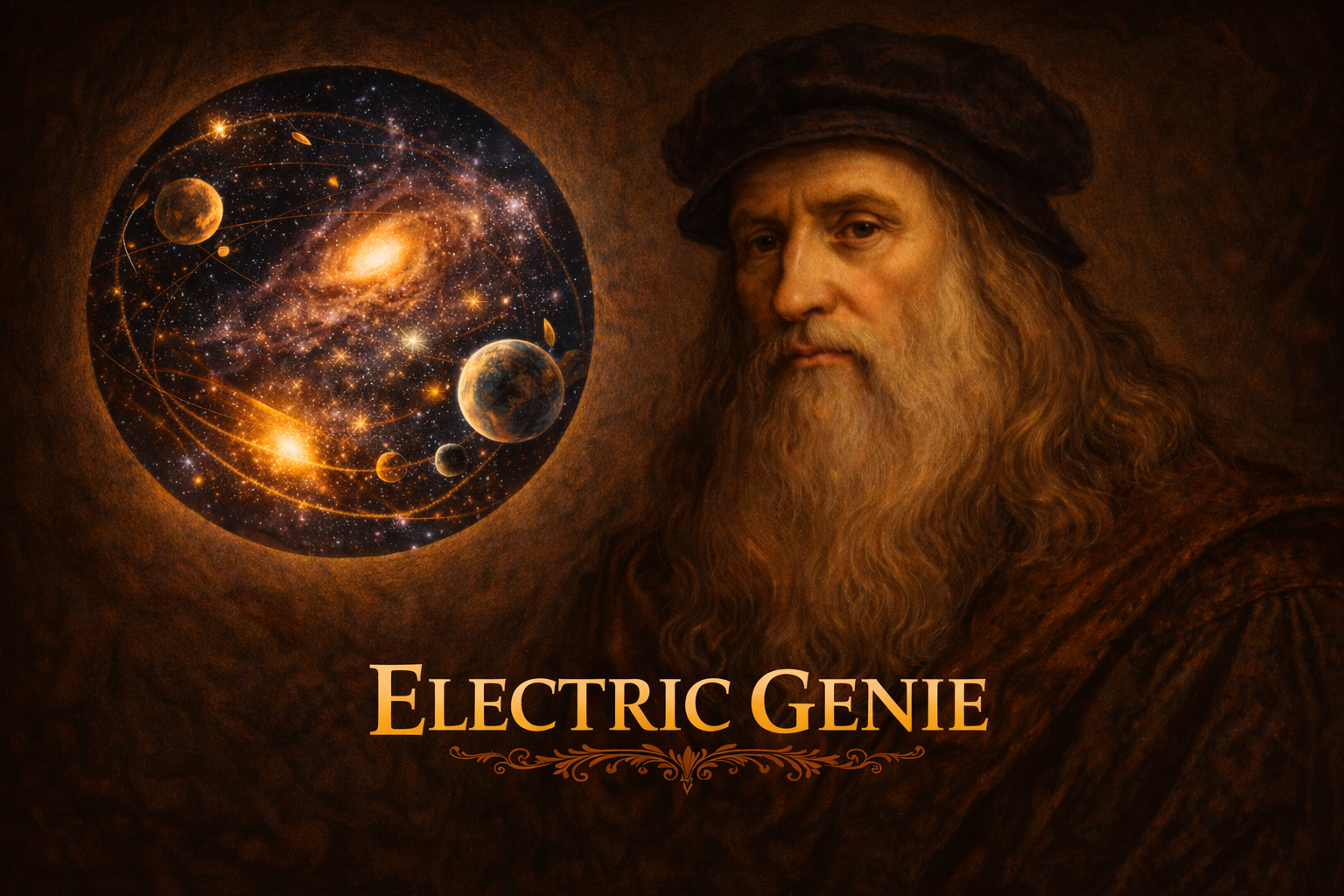
TITLE: Electric Genie
Summary: After dreaming of a mysterious Genie who offers him one wish, Leonardo da Vinci asks to know the secrets of the universe. Instead of giving him the answer, the Genie poses him questions. Years later, Da Vinci explores a strange cave called Vitruvia. The experience lingers in his mind and returns to him in dreams of lightning. When he later studies the human brain, it leads him to a profound insight: the universe people search for may not exist outside us, but may simply be a concept invented by the mind itself.
***
One night, as Leonardo da Vinci slept beside a table scattered with sketches and unfinished ideas, he dreamed that a strange figure appeared before him—a Genie, formed from flickering light and shadow. The figure spoke softly, as if the words had travelled a great distance to reach him.
“I will grant you one wish,” it said. “Ask for anything you desire.” Da Vinci did not ask for wealth, nor power, nor fame. After a moment of thought he answered simply:
“Show me the secrets of the universe.” The Genie smiled, as though the request was both expected and inevitable. “Very well,” it replied.
The darkness around them opened, and before Leonardo appeared an immense ladder rising endlessly into the heavens. Each step held a different form of existence.
At the lowest level lay stone and earth, silent and unmoving.
Above them grew plants, rooted in the soil yet reaching toward the light.
Above the plants moved animals across the land and birds through the sky.
Above the animals stood human beings.
And beyond humanity were the angels and the gods.
Unlike every other creature, the human being was not fixed to a single place in this order. Stones could only remain stone, plants could only grow as plants, and animals could only live as animals.
However, humans possessed something different. Sometimes it climbed upward toward the light, seeking knowledge, virtue, and the divine. At other times it slipped downward toward the darker steps below, drawn by instinct, ignorance, and desire. Humanity alone stood in motion within the hierarchy of being, capable of rising toward the heavens or falling back toward the earth.
High above them, a distant bolt of lightning tore across the heavens, and for a single instant the entire ladder of existence stood illuminated from earth to the stars.
“All other creatures simply exist,” the Genie said quietly. “Only mankind asks what reality truly is.”
The ladder slowly dissolved into darkness.
Then the Genie turned toward Leonardo and asked…
Where does truth begin?
For generations, people in the hills outside Florence spoke of a place called Vitruvia, the Cave of Truth. According to the old stories, somewhere within its dark chambers lay the secret of the universe. Some believed the cave held a message written by nature itself, while others imagined it guarded a truth meant only for those curious enough to seek it out.
Most people dismissed the story as nothing more than a wandering legend carried by the winds.
But Leonardo da Vinci had never been satisfied with myths.
From a young age he searched for patterns hidden in the world around him: the way water curved through rivers, the balance that held birds in the air, the geometry guiding the movement of light across stone. To Da Vinci, nature was never random. It was a puzzle waiting to be understood, and every mystery was an invitation to look closer.
And so one evening, as the sun lowered behind the hills of Florence, Da Vinci began climbing the mountain where the cave was said to lie. The path rose slowly through stone and shadow, each step carrying him further from the world below.
By the time he reached the summit, the valley had grown quiet beneath the fading light.
There, near the peak, he found the entrance to the cave.
It was little more than a narrow fracture in the rock, dark and silent, as though the mountain itself had opened to reveal something hidden within. For a moment Leonardo paused and looked back across the vast landscape below.
Then he turned and stepped into the darkness of Vitruvia.
*
The dream returned another night.
Again Leonardo stood beside the mysterious Genie. Once more the great ladder appeared, stretching upward through the heavens.
But this time he noticed something different.
The ladder itself was made of light.
At the lowest levels the glow was faint, and the shapes there were dim and uncertain. But higher up the ladder the light grew stronger. Plants became clearer, animals more defined, and the heavens above shone with brilliant stars.
A human figure began to climb.
With each step the light around it grew brighter, revealing more of the world that had always been there.
“The universe does not change,” the Genie said. “Only the light by which it is seen.”
A sudden arc of lightning flashed through the sky, and the ladder blazed with a brilliance so fierce that every step shone as though the universe itself had briefly caught fire.
The ladder faded slowly from sight.
Darkness returned.
And the Genie asked…
What does light reveal?
The cave twisted inward like a labyrinth. Passages curved unexpectedly, splitting into narrow tunnels that vanished into darkness.
Da Vinci moved carefully through the maze, his hand brushing the cool stone walls as he walked. From his bag he removed a sheet of paper and a quill. At each turning he paused to sketch the path he had taken. Line by line, the cave began to unfold beneath his hand, the drawing growing into a web of winding passages that mirrored the journey he was making through the dark.
The deeper he walked, the quieter the world became.
Soon the sounds of the hills were gone entirely, replaced only by the faint echo of his own footsteps. The map on the page grew more intricate with every turn; curves branching into new corridors, narrow paths leading toward a center he had not yet reached.
Certain that the secret spoken of in the old stories must lie somewhere at the heart of the labyrinth, Da Vinci continued forward.
At last the tunnels opened into a small chamber.
The cave ended there.
The room was empty and silent, untouched by sunlight. Only two small gemstones rested on the floor near the center of the chamber; one placed slightly to the left, the other to the right.
Da Vinci bent down, picked them up, and turned them slowly in his hands.
Curious, he struck them together.
Suddenly sparks burst into the darkness.
For a brief instant the chamber filled with light. Shadows sprang across the cave walls—and then everything fell silent again.
The sparks vanished as quickly as they had appeared, leaving the chamber once again in darkness. Yet the image lingered in Da Vinci’s mind: the sudden flash of light, the shadows springing briefly to life upon the cave walls before dissolving again into silence.
He struck the gemstones once more, watching the tiny stars scatter through the air.
Light appeared.
Then disappeared.
It was a simple moment, almost trivial, yet something about it felt strangely important.
Da Vinci slipped the stones into his satchel, folded the map he had drawn of the labyrinth, and began the long walk back through the tunnels toward the fading light of the outside world.
*
Years later the dream returned for a final time.
Leonardo stood again beside the Genie, and once more the ladder of existence appeared before him.
But this time something strange happened.
As he studied it more closely, the steps began to twist and curve. The ladder folded inward, forming chambers and branching pathways like a vast labyrinth.
Slowly the structure transformed into something familiar.
The intricate folds of the human brain.
What he had once believed to be a ladder rising through the universe now appeared to be a map of the mind itself. Along its pathways small flashes of light moved like sparks of thought in darkness.
A silent flash of lightning rippled through the labyrinth, and for an instant the pathways of the brain glowed like a storm of living light.
The Genie watched him quietly as he studied the strange vision.
“Perhaps the world is not something the mind discovers,” the Genie said softly, “but a dream the brain slowly learns to see.”
Then it asked its final question…
Is the universe inside the mind?
Years later, Da Vinci found himself studying the human brain by candlelight.
Its delicate structure folded inward again and again, forming chambers and passages that reminded him of the cave’s twisting corridors. From these folds stretched fine threads: the nerves, branching through the body like hidden pathways.
As he examined the intricate labyrinth before him, an old memory returned: the maze of the cave, the map he had drawn, the sparks bursting into darkness.
For the first time, the connection between them began to form.
He reached for one of his old notebooks and carefully unfolded the page on which he had drawn the map of Vitruvia. The ink had faded slightly with time, but the winding passages were still clear.
He placed the drawing beside the sketches of the brain and leaned closer to the candlelight.
At first the resemblance seemed faint, almost accidental.
But the longer he looked, the more the lines began to align.
The tunnels of the cave curved and branched in ways that echoed the folds before him. What he had once believed to be a wandering labyrinth of stone now appeared strangely ordered.
Da Vinci traced the lines slowly with his finger.
One passage curved inward; the brain folded the same way.
Another path divided in two; the structure before him divided at the same place.
Even the small chamber at the center of the cave, where the two gemstones had rested, one to the left and one to the right, seemed to mirror the hemispheres of the mind itself.
Like the sparks he had struck in the cave, ideas seemed to flash suddenly into the darkness of the mind, illuminating it for a moment before fading again.
For a long time he sat in silence, studying the map and the brain side by side.
Each idea had appeared suddenly, as if from nowhere—like a spark bursting briefly in darkness.
His thoughts wandered through the many questions that had filled his life: the spiral currents of rivers he had traced in his notebooks, the wings of birds that had inspired his flying machines, the hidden mechanics of gears and engines he imagined could move mountains, the subtle expressions captured in his paintings.
Yet now they no longer seemed random.
The mind did not merely witness the world; it gave the world its form, its patterns, its meaning. Perhaps the universe people searched for was not a place at all, but the grandest map the mind had ever drawn, an attempt to trace order through the scattered sparks of experience.
Da Vinci sat quietly for a long moment, the candlelight flickering across the pages before him.
Then, slowly, he reached for his quill.
A sudden intensity seized him, as if a hidden current had rushed through his mind and set every thought ablaze. Da Vinci pushed aside the scattered sketches on his table and reached for a fresh sheet of paper. His hand moved quickly now, guided by an idea forming faster than he could fully grasp it.
For centuries philosophers had drawn ladders, hierarchies, and shapes to explain the order of the cosmos. Yet now Leonardo wondered whether those structures belonged not to the universe, but to the mind that imagined them.
First he drew a circle; smooth and unbroken, his quill moving with such care that the line closed upon itself without the slightest hesitation, like the turning of the heavens.
Then he traced a square; each side measured with patient exactness, the angles meeting cleanly and firmly, grounded like the geometry of the earth itself.
At the center he placed the figure of a man, arms and legs extended outward until they touched the boundaries of both shapes. For a moment he stared at the image in silence.
Suddenly a flash of lightning split the sky beyond the window. For an instant the room blazed with white light, and the figure on the page seemed to stand at the center of the universe itself.
When the darkness returned, Leonardo remained motionless.
The ladder of existence, the labyrinth of the cave, the sparks in darkness, the branching folds of the brain, all were maps of the same mystery.
Perhaps the universe was not something waiting to be discovered beyond the world.
Perhaps it was something the mind had been drawing all along.
At last, it all made sense.