

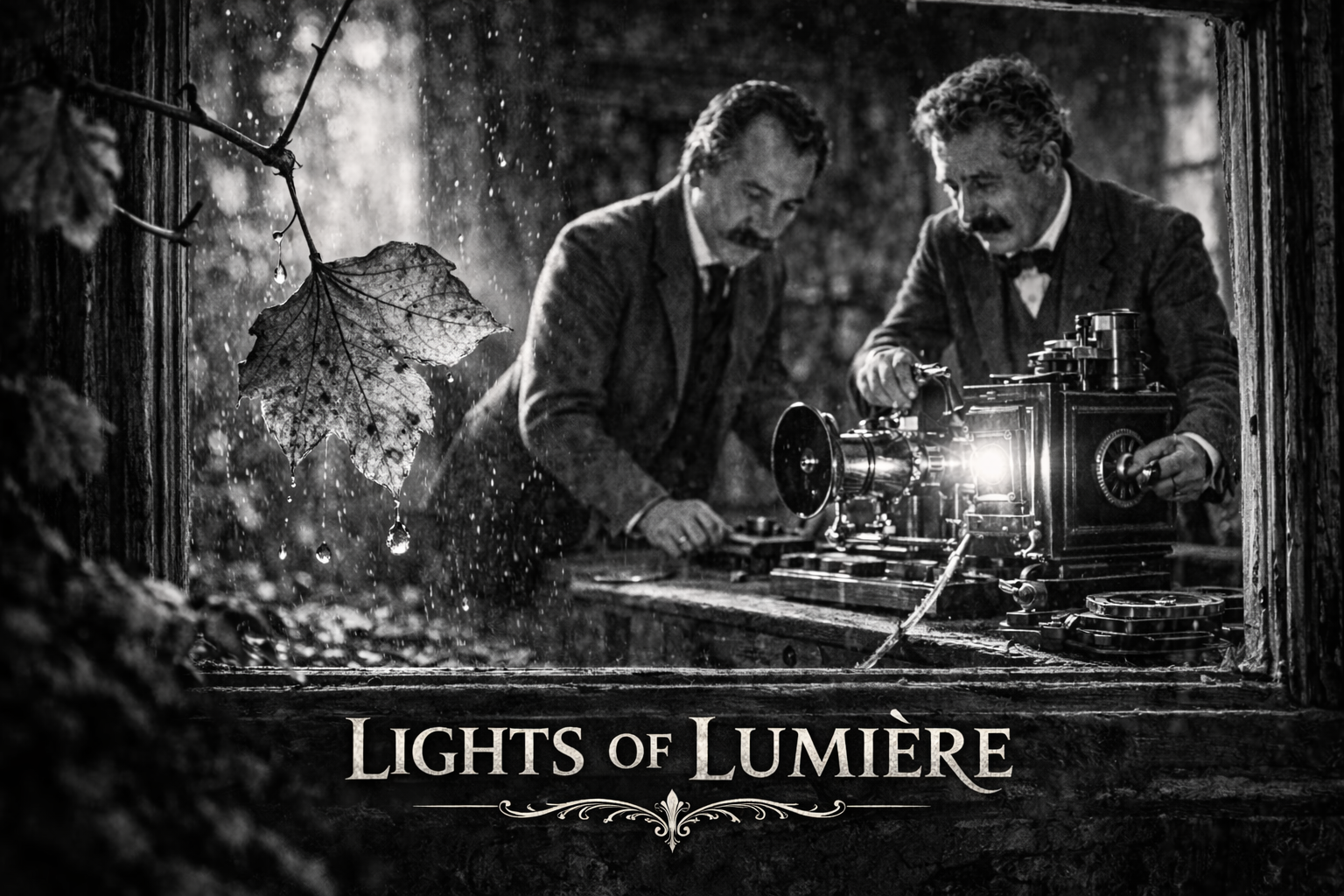
TITLE: LIGHTS OF LUMIÈRE
Lumière
In the closing years of the nineteenth century, rumors of a remarkable invention began circulating through Europe.
The device, created by the brothers Louis Lumière and Auguste Lumière, was called the Cinématographe.
Unlike the still photographs that had already become fashionable, this machine could capture life in motion and project it onto a wall through flickering electric light. For the first time, a moment could be preserved exactly as it unfolded; a gesture, a glance, a movement that would normally vanish as quickly as it appeared.
People spoke of the invention with fascination and curiosity. Some believed it would be little more than a scientific novelty.
Yet the Lumière brothers sensed something deeper within the strange images their machine produced. Somewhere inside those flickering frames, they suspected, there might be a hidden beauty waiting to be understood.
However, they did not yet know what their camera should show.
Caméra
Inside their workshop in Lyon, the brothers continued experimenting with their invention.
Strips of film lay coiled across wooden tables beside lenses, tools, and trays of chemicals. The cinematograph stood nearby, its brass mechanism glowing beneath the lamplight. Louis turned the small hand crank, and the machine answered with a steady clicking sound as the film advanced frame by frame.
Yet even as they tested their device, they remained uncertain what cinema was truly meant to capture.
One afternoon Louis paused beside the tall window overlooking the garden behind the workshop. Outside, autumn rain drifted through the branches of a nearby tree. The leaves trembled gently in the wind, their surfaces darkened by the rain.
One leaf clung stubbornly to the end of a thin branch.
A droplet of water gathered slowly along its edge.
For a moment the leaf shivered.
Then the droplet slipped.
The branch bent slightly, and the leaf released itself into the air, turning softly as it fell toward the ground.
The moment lasted only an instant.
Action
Curious, the brothers carried the cinematograph outside and aimed the camera toward the branches of the tree. Louis began turning the small hand crank, and the machine answered with its steady mechanical rhythm as the film advanced frame by frame. The rain continued to fall as the camera watched the tree in silence.
Soon the moment appeared again: the trembling leaf, the gathering droplet, the soft release into the air.
Later, inside the dim workshop, they threaded the film through the projector and cast the image upon the wall.
The leaf fell again.
The droplet formed again.
The moment unfolded once more in flickering light.
The brothers unwound the ribbon of film across the worktable and studied the tiny frames beneath the lamplight. Each image showed the leaf at a slightly different point in its fall. With careful hands they threaded the strip again through the projector.
When the image returned to the wall, the moment appeared differently.
The droplet lingered before it slipped.
The leaf turned slower through the air.
Its delicate veins caught the beam of light.
What had lasted only a second outside now unfolded slowly before them.
The camera had captured something the eye itself could barely hold; a fleeting instant suspended in light.
A movement too delicate for memory had been preserved within a ribbon of images.
For the first time, a moment that belonged to Time had been held still.