
TITLE: Electric Demon
Pierre-Simon Laplace begins to suspect that the universe is incomplete.
Science describes a perfectly ordered world where every possibility exists: every colour within the spectrum, every side of a coin, every state of the mind. Yet Laplace notices something strange. In practice, certain possibilities never appear.
The world seems subtly edited.
To test this suspicion he places three objects before him: a colour wheel, a coin, and a mirror that watches over both.
Laplace decides that if reality is withholding something, he will ask for it directly.
The first experiment concerns perception.
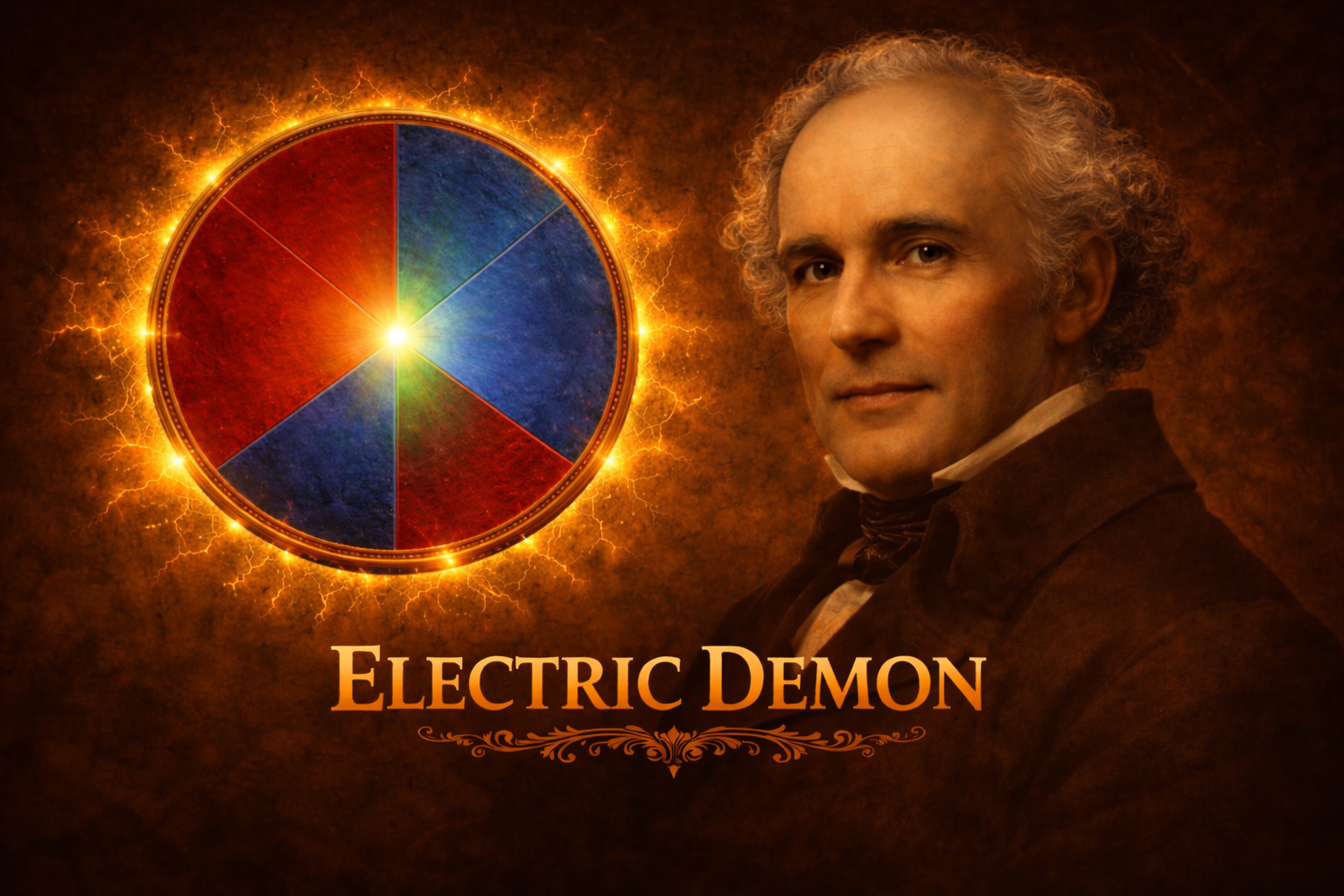
Laplace’s colour wheel is divided into red, green, and blue, the primary colours of light. Each evening he spins the wheel and observes where it lands.
Again and again the wheel stops on red or blue.
Green never appears.
After weeks of observation Laplace begins to feel that perception itself has been narrowed, as if one colour has been removed from the world.
One night he speaks softly into the empty room.
If green exists… show it to me.
The wheel spins.
It slows.
For the first time it lands on green.
The second experiment concerns chance.
Laplace flips a small coin before beginning his work. A fair coin should produce heads or tails, yet the coin lands on heads every time.
Probability insists tails must appear eventually.
Reality disagrees.
After many nights Laplace speaks again.
If tails exists… show it to me.
The coin rises, spins, and falls softly into his hand.
Tails.
The final experiment concerns the mind.
Each morning Laplace wakes remembering only the waking world. Dreams vanish before they can be examined.
Yet he knows the mind must move between different states.
One night he whispers his final request.
If dreaming exists… show it to me.
That night Laplace awakens inside his study.
He is dreaming—but he knows he is dreaming.
The room looks the same: the wheel, the coin, the mirror waiting on the desk.
Laplace walks slowly toward the mirror.
The reflection staring back at him glows faintly green in the lamplight.
At first he assumes it is only the strange colour from the wheel reflected in the glass. But as he leans closer, the details sharpen.
Two small horns rise from the temples of the figure in the mirror.
The skin is pale green.
Laplace raises the coin toward the glass.
Both sides bear the face of a small demon. Its eyes are closed.
For a long moment, nothing moves.
Then the demon in the mirror opens its eyes.
They are his.
Author’s Note
Electric Demon draws inspiration from Laplace’s demon, a philosophical idea proposed by Pierre-Simon Laplace. Laplace imagined a powerful intelligence that could know the position and motion of every particle in the universe at a single moment. With perfect knowledge of the laws of physics, such a mind could calculate the entire past and future of the universe. The idea was meant to illustrate a deterministic view of reality—one where every event follows logically from what came before.
Instead of focusing on prediction, Electric Demon explores observation, chance, and consciousness through symbolic objects like a colour wheel, a coin, and a mirror. The demon that appears in the story is not meant to represent Laplace’s original idea exactly, but rather a fictional interpretation that imagines what might happen if the observer became part of the system they were trying to understand.