
TITLE: GHOSTLIGHT
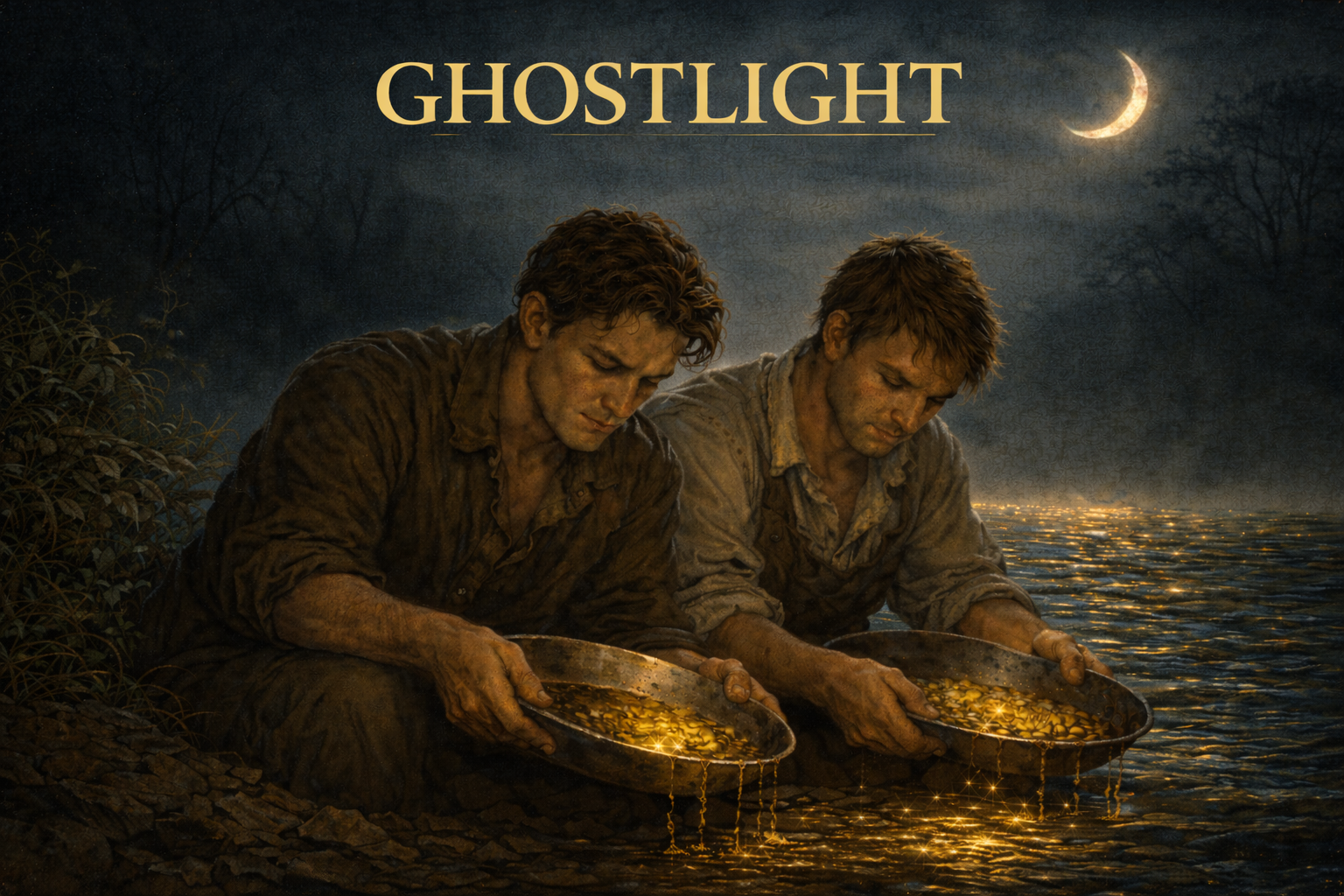
Summary: Ghostlight follows two brothers, Kane and Albert, living in 1850’s Ballarat during the Australian gold rush. Kane is confident, charming, and adored by others while Albert is quiet and often overlooked.
When Albert unexpectedly discovers gold by the river, everything shifts. The more gold he finds, the more attention he receives and the more Kane’s jealousy grows. Kane begins watching him closely, feeling his brother slip out of his shadow and into the light.
I. SUNLIGHT (Albert)
In Ballarat, light was its own creature. It struck the river first each morning, a single blade of gold slicing across the water, shimmering as if it knew where it wanted to land. It had always found Kane. Even as boys, Father said Kane’s gaze “held the sun,” and everyone seemed to agree; men brightened around him, and women softened, lingering in doorways to catch his eye.
I walked beside him, unseen; until that morning.
I bent over the creek, swirling my pan through cold grit, when the sun slipped between two plants in a sudden, clean beam. It hit the shallows, turning grey pale stones pale into glinting diamonds. A thin shimmer drifted in the current, and I followed it. When the light steadied, real gold lay in my pan — warm, heavy, dazzling.
The men came first, boots snapping twigs, voices eager. Their eyes reflected the brightness in my hands. Then the women, their gazes landing on me with a soft, curious weight I had never felt.
Father arrived last, breathless. His eyes found mine, not Kane’s, mine, and something warm flickered there, something I’d never earned from him before.
Out of the corner of my eye, Kane watched, his arms folded a little too tight across his chest. His jaw worked once, as if he were chewing on something hard. His eyes, usually bright, dulled by a shade, barely anything, but enough to twinge the air between us.
The river sent up a second flash, bright in my face.
And for the first time, the light chose me.
II. STARLIGHT (Albert)
Starlight hit the river differently, colder and sharper, carving a silver line across the black water. One night a bright, burning star rose above camp, and its reflection trembled on the river as though waiting for someone to follow it. When I walked toward it, the starlight scattered across the surface and leapt into my eyes.
I panned three times. Each time, gold rose from the mud. The river glowed back at me as if pleased with its find. When I returned to camp, the men surrounded me. Their eyes shone, wide and greedy, full of admiration. “Golden Boy,” someone called, and just like that the name stuck.
The women watched me too. Their looks no longer slid past me to Kane. They lingered. One girl’s stare caught mine and held it, the starlight reflecting in her eyes and mine.
Father’s gaze burned with a bright, startled pride, the kind of pride he had always saved for my brother. I turned to Kane, wanting to share the moment, wanting him beside me in the glow. But the light hit his eyes differently.
Not bright now, but muted, as if the light had skimmed past him without finding anything to catch. He shifted back a step, letting the shadows take him.
III. MOONLIGHT (Kane)
Moonlight hit the river with its own cruelty. It spread across the surface in a thin, bloodless sheet, draining colour from everything it touched—except Albert. He knelt at the water’s edge, where the pale light seemed to gather and harden on him, catching the gold dust on his sleeves and sharpening his eyes into something I have never seen before.
I remembered when those eyes had been soft and shaded. When he had watched me with a kind of gentle awe, his gaze catching only what I reflected. But the river had turned toward him, and the light followed. The men admired him openly. The women whispered his name. Even Father looked at him with a brightness that once belonged to me.
“Look,” Albert whispered, lifting a flake of gold so thin it seemed to slice the moonlight in two. His eyes caught the glow, and something twisted in my chest. It felt sudden and old at the same time — the sense that he no longer needed me, and that maybe he never had.
He frowned, stepped closer, reached for my arm. That gentle concern, that unshaken trust, only twisted the sourness deeper. My hand went out to steady him, or push him away, or both. Our balance shifted. The stone beneath him rolled.
He slipped.
He hit the water hard, the splash sharp and sudden. For a heartbeat he surfaced, sputtering, arms flailing in blind instinct. His hand broke the surface, reaching for me. I took a half-step toward him, then stopped, frozen.
The river dragged at him. His head vanished, rose again, vanished once more. Each time he surfaced, the struggle was weaker. A choked gasp. A desperate kick. Then only his fingertips appeared, trembling, before they slipped under for the last time.
The river held him beneath, while the moon watched in silence. The glint in his eyes — that fragile spark of borrowed light, vanished as the water claimed him.
IV. AFTERLIGHT (Kane)
Everyone believed me when I said he slipped. Why wouldn’t they? I had been the bright one my whole life. They mourned him loudly, men cursing the river, women weeping into their shawls, Father stiff-jawed and silent.
Albert’s gold sat in my pocket like a lump of cold metal. When I tried to hold it to the sun, it did not shine. When I crouched by the river, looking into the dark water, there were no flashes, no gleams, no reflections dancing across my face.
Night after night I returned to the darkness. I watched until my vision blurred. Sometimes, when my eyes grew tired enough, I thought I saw something flicker below the surface: a pale suggestion of a face, a hint of light where there should have been only stone and silt.
Every time I blinked, it vanished, leaving only my reflection staring back—hollow-eyed, rimmed with shadow, carrying no shine at all.
What remained was an afterglow, not warm, not bright, just a lingering, sickly remnant of light twisting inside me. Father did not ask questions. He only watched me with a shadowed expression, as though he could sense the gap between what I said and what the river knew.
V. FIRELIGHT (Adam)
The night my son Albert died, the bush fell quiet in a way I had heard only once before, the day a stockman hanged himself out past the ridge. That same heavy silence swallowed the insects and frogs and tightened the air until it hurt to breathe.
I found Kane first, on his knees at the river’s edge, hands buried in wet sand, chest shaking. When he looked up, his eyes were hollowed-out things, stripped of the shine they once carried. Then I saw Albert. He lay where the water met the earth, as if the river had tried to return him and lost its nerve halfway.
“Slipped,” Kane whispered. “He slipped father” But he would not meet my eyes.
Fire would stop the questions. A body invites rumours. Rumours turn cruel out here.
We built the pyre together. Kane’s hands shook, but he did not resist. When the wood was stacked high, we lifted Albert, lighter than he had ever been in life, and laid him gently at its center. I struck the flint. Flame caught on the second spark and surged, wrapping my son in a shroud of orange light.
For the first time I saw him clearly. The fire carved his face in flickering frames, boy, man, stranger, son, and I understood too late that he had always carried a light of his own. Kane sobbed beside me. I placed an arm around him, though nothing I did could bridge what lay between us.
VI. GHOSTLIGHT (Adam)
The next morning, the river shone with a colour I had never seen — neither gold nor moonlight, but something pale and trembling, like a memory lifting from the depths. Mist curled along the surface, settling around the reeds in soft, wavering bands. The bush held its breath again, waiting.
Kane lingered at the tree line. His eyes, once bright as flame, were hollow lanterns now, carrying only a faint flicker. He would not step closer. Perhaps he feared what he would see in the river, or what the river would see in him.
I walked down alone. Ash from the pyre still clung to my hands, settled into the lines of my palms as if Albert refused to leave my skin. The air smelled of burned eucalyptus and wet stone.
Then the river brightened, not from the sky but from beneath. A soft glow rippled outward from the center of the creek, gathering strength, a ghost of the flash Albert once carried in his eyes. The water shimmered as though something underneath was trying to speak in light.
For a heartbeat I saw the shape of a face — blurred, only the hint of eyes glowing faintly beneath the surface. My breath caught. Kane lurched forward with a choking sound.
Then the river broke, a single bubble rising — small, yet it looked like a light struggling upward. “Albert?” I whispered. The ghostlight quivered. A pale ring drifted toward the bank and brushed my boots. Kane folded into himself, grief and guilt collapsing him. When the glow touched him, a thin silver glimmer clung to his tears.
Some lights do not die with a body. His was one of them. His spirit lingered here, gathered in the glow that rose from the river. When the water stilled, the shimmer slipped beneath the surface, as though he had spoken his last word and returned to the depths.
I knew what I had witnessed, not superstition, but the last trace of a boy who had waited too long for the light to choose him. And as the sun broke over the ridge, I understood:
Albert had never belonged to us.
He had belonged to the light.
And the light, even in ghost-form,
had come to take him home.